

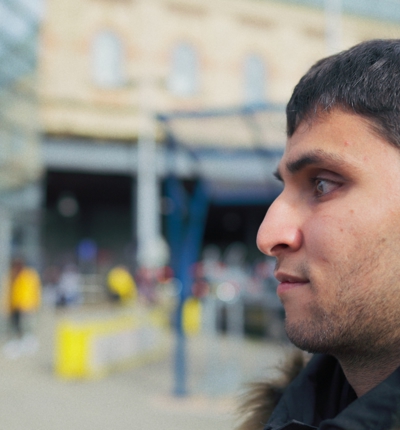
Settlement secured for blind student who fell on to Manchester Piccadilly station tracks
Abdul Eneser, a blind man who fell on to train tracks at Manchester Piccadilly station and narrowly missed being hit by a freight train, has settled his case against Network Rail.
Posted on 22 January 2026
The national company did not admit liability but agreed to pay 23-year-old Abdul compensation for the catastrophic incident of 21 May 2022.
Abdul, a masters law student at University of Strathclyde, fell on to the tracks at Manchester Piccadilly platform 14 after Passenger Assist failed to meet him from his train and help him through the station after a train delay.
The lack of tactile paving near to the platform edge meant Abdul was unaware how near he was to the drop on to the railway line.
He fell on to the tracks, suffering injuries, and only managed to pull himself back on to the platform one minute before a non-stop freight train passed through the station on the same track. Abdul suffered injuries to his knees, hands and neck, as well as ongoing anxiety when travelling.
Abdul had booked Passenger Assist in advance. He was assisted to board his Avanti train at Glasgow, however, due to delays he missed his connection to Manchester and had to wait 90 minutes for the next Northern train. At Preston, Avanti staff helped Abdul to board his train to Manchester Piccadilly, and he was told that they would radio through to Piccadilly to tell them that he was on the train and his seat number.
But when Abdul arrived at platform 14 at Piccadilly after midnight, no one from Passenger Assist was there to support him. He was later told that they had all gone home.
Abdul fell as he tried to find the steps to leave the station from platform 14.
Later Abdul instructed Kate Egerton at law firm Leigh Day to bring a case against Network Rail and the train operators for failing to install tactile paving at the station, or implement other warnings such as audio announcements, or ensure the presence of station staff, to protect him.
Abdul’s claim was issued at court in November 2022 arguing that Network Rail had breaches its duties under the 2010 Equality Act and the Occupiers Liability Act 1957, and were negligent.
Under the Equality Act, Abdul argued that Network Rail had failed to make reasonable adjustments to ensure that passengers with disabilities, such as visual impairments, were not at a substantial disadvantage by the physical features of the station, including the lack of tactile paving. Abdul also sought remedial action as part of his legal claim, including the installation of tactile paving.
In November 2025, the court approved a consent order providing a five-figure settlement sum to Abdul. This followed a public announcement in July 2025 that Network Rail had installed tactile paving across the network after the tragic death of a blind man, Cleveland Gervais, in 2020.
Whilst Abdul describes a sense of “vindication” following the settlement, he says that there is still much more to be done to ensure that UK trains stations and rail journeys are accessible to those with visual impairments.
For example, Abdul believes that a live-chat feature on the Passenger Assist app, so that passengers could contact staff members if something went wrong during their journey, would greatly assist disabled people. He also notes that a clearly marked Passenger Assist help button at the entrance to every train station could aid passengers with visual impairments when navigating unfamiliar stations.
Abdul Eneser said:
"This case is about much more than compensation. Poor accessibility in rail travel is not just a one-off issue. This is something that prevents myself and others with visual impairments from travelling with confidence.
“I’m not always sure that I’ll be met with the right level of support to complete my journeys. At the best of times, it makes travel stressful, and in the worst-case scenario it can be really dangerous.”
Human rights team senior associate solicitor Kate Egerton said:
“Ensuring that stations are accessible for blind and visually impaired people is crucial to ensuring they can travel safely on an equal basis to fully sighted passengers.
“Network Rail and Train Operators have a clear obligation to ensure that train stations are accessible for all. Not only is it distressing for passengers with visual impairments to try to navigate inaccessible platforms and services, it is also extremely dangerous.
“Whilst I am pleased that we were able to secure this settlement for Abdul, his case and continued experiences highlight wider accessibility issues across the rail network that need to be addressed.”
- Separately, on Thursday 22 January, the Royal National Institute of Blind People (RNIB) released a report titled ‘Platform for Change: making rail journeys more accessible for people with sight loss’. The report highlights that just 44% of blind and partially sighted people are “reliably met by staff at their destination or connecting station” and 48% said they only “sometimes” are met by staff when alighting their train.
Abdul responded to the report, noting that the findings “are stark but sadly unsurprising. When one in four people say their booked assistance simply didn't show up, and nearly half are only sometimes met by staff, it's clear the current system isn't working.”
He added, “What we need is consistency - standardised meeting points at every station so passengers know exactly where to go, and proper digital solutions that allow immediate two-way communication directly with staff at the station you're travelling to, not a call centre hundreds of miles away. That kind of direct line would mean if something goes wrong - a delay, a platform change - you're not left stranded wondering if anyone's coming to help you.”
Kate Egerton
Kate Egerton is a senior associate solicitor in the human rights department.

Blind man who fell on to tracks at Manchester Piccadilly calls for urgent upgrade of safe travel provision with tactile paving in train stations
A blind man who fell on to the tracks at Manchester Piccadilly after he was let down by Passenger Assist and there was no tactile paving at the platform edge is calling for urgent action to improve provision for disabled people travelling on trains.
Inquest jury concludes lack of tactile paving contributed to death of blind man Cleveland Gervais, aged 53
An inquest jury has concluded that a lack of tactile paving caused or contributed to the death of Cleveland Gervais, aged 53, at Eden Park overground station in Croydon and that insufficient steps to confirm the power to the track was off caused an avoidable delay which also caused or contributed to his death.